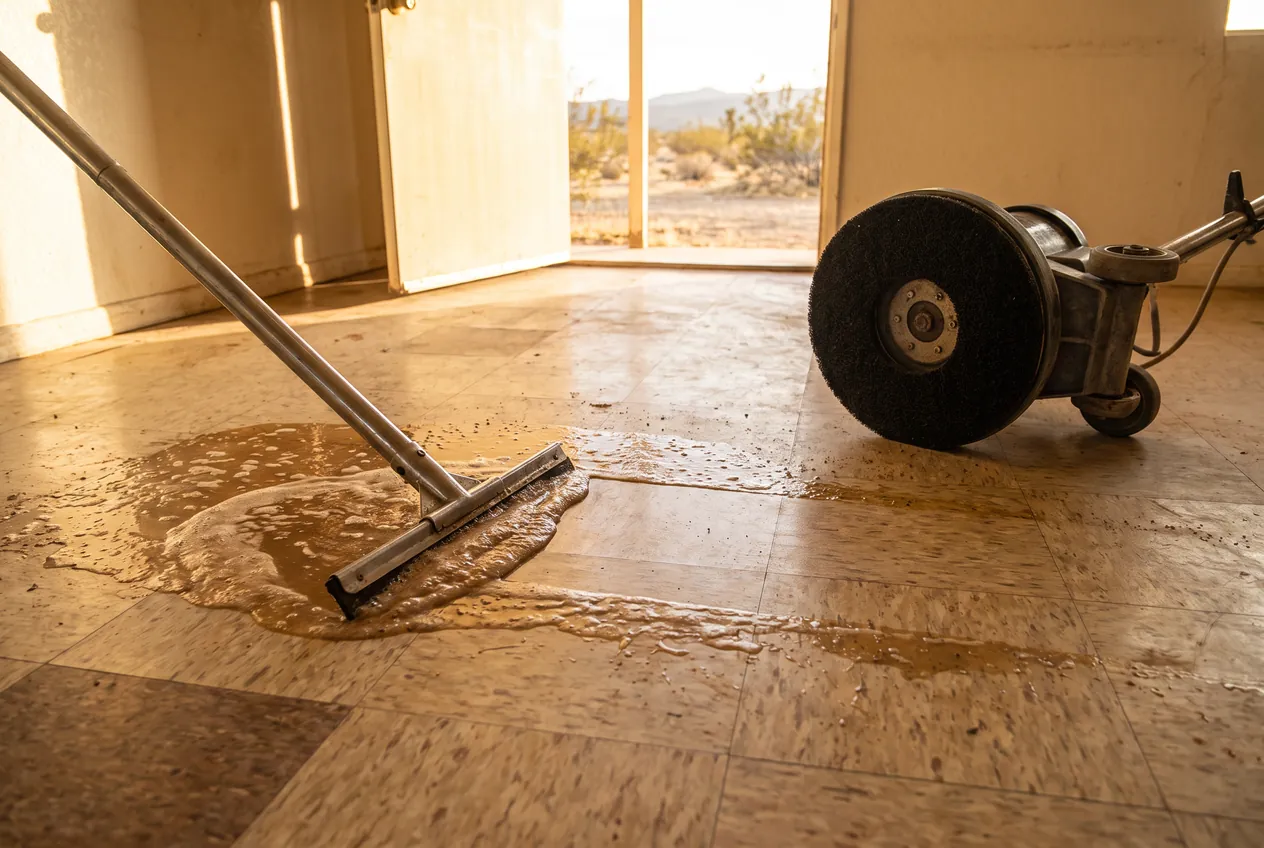
What strip and wax means on a commercial floor
The phrase is older than the products. Very few commercial floors get actual wax anymore. What goes down today is an acrylic floor finish, a liquid polymer that dries into a hard, clear layer and takes the scuffs and grit so the tile underneath does not. Over months of traffic that layer wears thin in the lanes, yellows in the corners and traps soil between coats. Stripping removes it entirely so a fresh finish can be built back up on clean tile.
The floor that gets this treatment most is VCT, vinyl composition tile, the hard, square tile common in break rooms, corridors, clinics, classrooms and retail back areas. It is durable but porous and dull without finish, so it depends on that coating for both looks and protection. That is why VCT floor stripping is a standing line item in most commercial floor programs.
The strip and wax process, step by step
Each step depends on the one before it. Skipping the rinse or rushing the drying time between coats is how a refinished floor peels, clouds or turns sticky within weeks. The table below follows the order a properly run job takes, with the reason each step exists.
| Step | What happens | Why it matters |
|---|---|---|
| Clear the room | Furniture, mats and bins moved out | Finish cannot go under what is still sitting on the floor |
| Dust mop | Loose grit and debris removed | Grit under the pad scratches the tile |
| Signs out | Wet floor signs at every entry | Stripper makes the floor extremely slick |
| Apply stripper | Solution spread and left to dwell | Dwell time does the chemical work, not elbow grease |
| Scrub | Low-speed machine with a stripping pad | Breaks the softened finish loose from the tile |
| Pick up slurry | Wet vacuum pulls up the residue | Slurry left to dry re-bonds to the floor |
| Rinse and neutralize | Clean water passes, often two, plus neutralizer | Leftover stripper stops new finish from bonding |
| Dry | Floor left fully dry | Moisture under finish clouds and peels |
| Finish coats | Several thin coats, usually 3 to 5 | Thin coats dry hard; thick coats stay soft |
| Burnish (optional) | High-speed machine once cured | Raises gloss and hardens the surface |
Floors that should never see stripper
Not every hard floor that looks like tile is VCT. Many luxury vinyl tile and plank products have a factory wear layer that stripping chemicals and aggressive pads can damage, and their makers say not to strip them. Older no-wax sheet vinyl falls in the same category. Before booking a strip, find out what the floor actually is and read the maker's care guidance. If nobody knows, the provider can usually identify it on the walk-through.
- Luxury vinyl tile and plank with a factory wear layer
- No-wax sheet vinyl
- Any floor whose manufacturer says not to strip it
- Sealed or polished concrete, which has its own care program
- Natural stone, which needs stone-specific products
- Rubber flooring unless the maker approves the method
Full strip, or scrub and recoat?
A full strip takes the floor down to bare tile. A scrub and recoat is the lighter cycle in between: the crew deep scrubs the top layer of finish to remove embedded soil and scuffs, rinses, and lays down one or two fresh coats without cutting through to the tile. It takes less time, uses less chemistry and keeps the base coats intact.
Most well-run floor programs alternate the two. Full stripping is often scheduled yearly or twice a year, depending on traffic, with scrub and recoat cycles between. A floor that only ever gets recoated eventually builds up too many layers with dirt trapped between them, and it starts to look yellow and blotchy. A floor that gets fully stripped too often wears out faster and costs more labor than it needs to.
Why the work happens after hours
Strip and wax is almost never a daytime job in an occupied building. The stripping chemistry has a strong odor and needs ventilation. The floor is dangerously slick from the moment stripper goes down until the last coat of finish dries. Each finish coat needs drying time before the next goes on, and the full job can run through a night. Facility managers usually book it for evenings, weekends or a slow stretch, and close off the affected rooms with signs and tape until the crew says the floor is ready for traffic.
Red sand and monsoon mud on a St. George finish
Floor finish in St. George takes a beating that many other markets do not see. Red sand blows in on wind days for most of the year, and that grit is abrasive. Every footstep grinds it into the finish, so entry lanes, corridors to the restrooms and the space in front of reception lose gloss first. In July and August, short monsoon storms add wet mud straight across the threshold, which sets into the finish if it sits overnight.
That pattern changes the schedule. Buildings here lean harder on scrub and recoat cycles in the high-traffic lanes, and many book the full strip for after storm season, so the new finish is not ruined by the next round of mud. Long entry matting, daily dust mopping and fast cleanup after a storm all stretch the time between full strips. Resort properties and medical buildings in Washington, where floors see traffic around the clock, often split the job into sections over several nights.
What to include when requesting a quote
Strip and wax floors cost depends on square footage, how many rooms and how much furniture must move, the floor's condition and how many finish coats are specified. A floor with years of buildup takes longer to strip than one on a regular cycle. A clear request lets every provider price the same job and avoids surprises on the night of the work.
- Approximate square footage of floor to be stripped
- Floor type, if known, and the maker's care guidance
- Rooms involved and how much furniture needs moving
- Number of finish coats wanted and whether to burnish
- Available work window: nights, weekends or both
- When the floor was last stripped or recoated