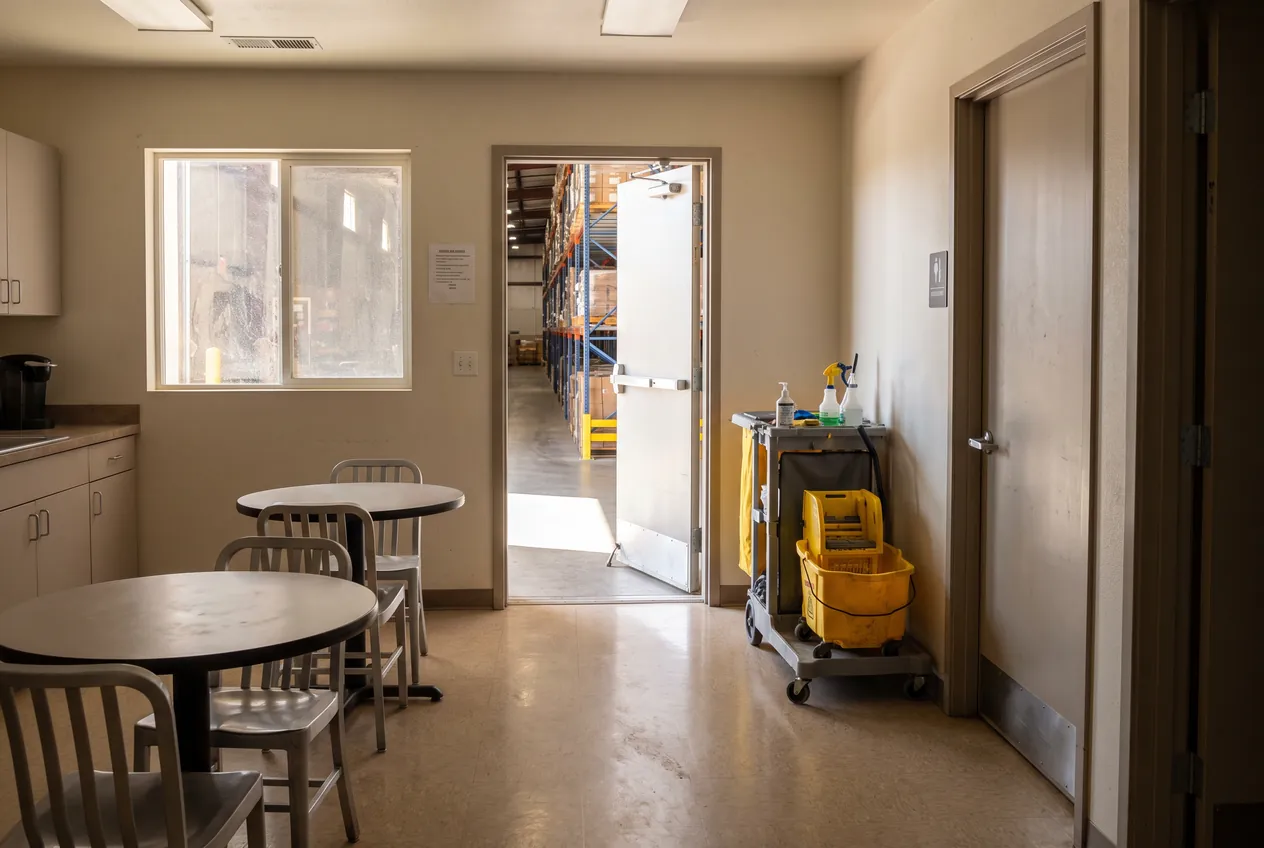
On a warehouse floor the machines do the heavy lifting. A ride-on sweeper picks up loose grit, splinters and strapping first, then an auto scrubber lays down solution, scrubs and squeegees the slab dry in one pass, which matters when forklifts need the aisle back quickly. Sealed concrete cleans up well this way, while bare concrete holds dust and may need extra passes. Drip spots under parked equipment get spot-treated before the scrubber reaches them. The office, break room, restrooms and locker room inside the building get an ordinary janitorial route with trash, surfaces, restocking and floors.
Safety shapes every part of the job. The crew follows the site's rules on vests, safety shoes and other required PPE, stays out of active aisles, and works in zones the floor supervisor has closed or that sit idle between shifts. In a 24-hour operation the building is never empty, so cleaning moves zone by zone on an agreed rotation. High dusting of racking, beams, light fixtures and HVAC returns is done from a lift by operators trained on that equipment. Federal workplace safety rules from OSHA expect walking and working surfaces to be kept clean, orderly and free of hazards.
The usual mistake is treating the floor as somebody else's problem until it turns into a hazard. Shrink wrap, banding and pallet chips pile up near docks and wrapping stations, and loose wrap under a boot or a wheel is a real risk. Another is dry sweeping with push brooms, which mostly lifts dust into the air and onto product. High areas get forgotten too: dust that sits on beams and light fixtures for a year drops back onto stock and freshly scrubbed floors. Finally, restrooms and the break room get skipped because the floor ate up all the time.
Warehouse floors and docks in the St. George desert
Warehouses in St. George sit in the middle of the same red-sand problem as every storefront in town, only with doors the size of a truck. Each time a dock door rolls up on a windy day, fine sand blows across the slab and settles into aisles, on pallet tops and along the bottom of the racking. Long dry stretches mean the dust never really gets washed down. When the July and August monsoon storms roll through, trucks and forklifts drag wet mud in from the yard and lay tracks across the floor that dry hard if nobody scrubs them.
Most warehouse cleaning is scheduled around the shift pattern. A single-shift building can be scrubbed in the evening or early morning while the floor is idle, while a round-the-clock operation is usually cleaned zone by zone, with the floor supervisor closing off one area at a time. High dusting is often planned for a slower week or a weekend. Requests tend to come from St. George, Washington and Hurricane, with some from Bloomington and Mesquite NV.
A typical warehouse cleaning schedule
| Task | Cadence |
|---|---|
| Dock sweep for wrap, banding and pallet debris | Daily or each shift |
| Warehouse floor auto scrub | Weekly to daily, depending on traffic |
| Restrooms, break room and locker rooms | Each working day |
| Office areas inside the warehouse | Several times a week |
| Drip and spill spot treatment | As found on each visit |
| Dock door tracks and entry mats | Weekly |
| High dusting of racking, beams and fixtures | Every 6 to 12 months |
This is the starting specification. After the walk-through, the provider adjusts the cadence to how your building actually operates.
What the scope normally covers
- Ride-on sweeping of aisles and open floor
- Auto scrubbing of sealed or bare concrete
- Dock cleanup of wrap, banding and pallet chips
- Break room, restroom and locker room cleaning
- Warehouse office trash, dusting and floors
- Spot treatment of drips and floor stains
- High dusting from a lift, when scheduled
- Trash and recycling to the compactor or dumpster
The final task list and cadence get specified between you and the provider when the quote gets written up.
What drives the cost of a warehouse clean
- Floor area and condition
- The amount of open slab is the biggest single driver. A sealed floor in good shape scrubs quickly, while dusty bare concrete or heavy tire marks need more passes and more machine time.
- Equipment and lift access
- Ride-on sweepers and auto scrubbers usually come with the crew. High dusting needs a lift and a trained operator, and whether the site supplies its own lift changes the scope.
- Shift pattern
- An idle building in the evening is the fastest to clean. A 24-hour operation cleaned zone by zone, around forklifts and pickers, takes longer and needs closer coordination with supervisors.
- Support spaces
- Offices, break rooms, restrooms and locker rooms often make up a large share of the routine visit. More of them, or heavier use across several shifts, adds daily janitorial time.
Related services in St. George
Cleaning for other types of business in St. George
- Restaurant Cleaning in St. George
- Church Cleaning in St. George
- School and Daycare Cleaning in St. George
Guides
Where requests tend to come from
Businesses across the St. George metro send us warehouse cleaning requests, from St. George, Washington, Hurricane, Ivins, Santa Clara, La Verkin and the surrounding towns. See all areas.